
A Virtual Workshop organized for 200 & 300 LEVEL Students of SPESSE Centre, University of Benin. Implemented by COMERC Trading and Technology Limited.
The SPESSE Career Readiness Workshop on Artificial Intelligence, which held from 9th to 13th March, 2026, was conceived as a strategic learning intervention for undergraduate students of the SPESSE Centre, University of Benin. At a time when Artificial Intelligence is rapidly reshaping education, research, work and social life, the workshop was designed to prepare students to understand, engage and respond to these changes in meaningful ways.
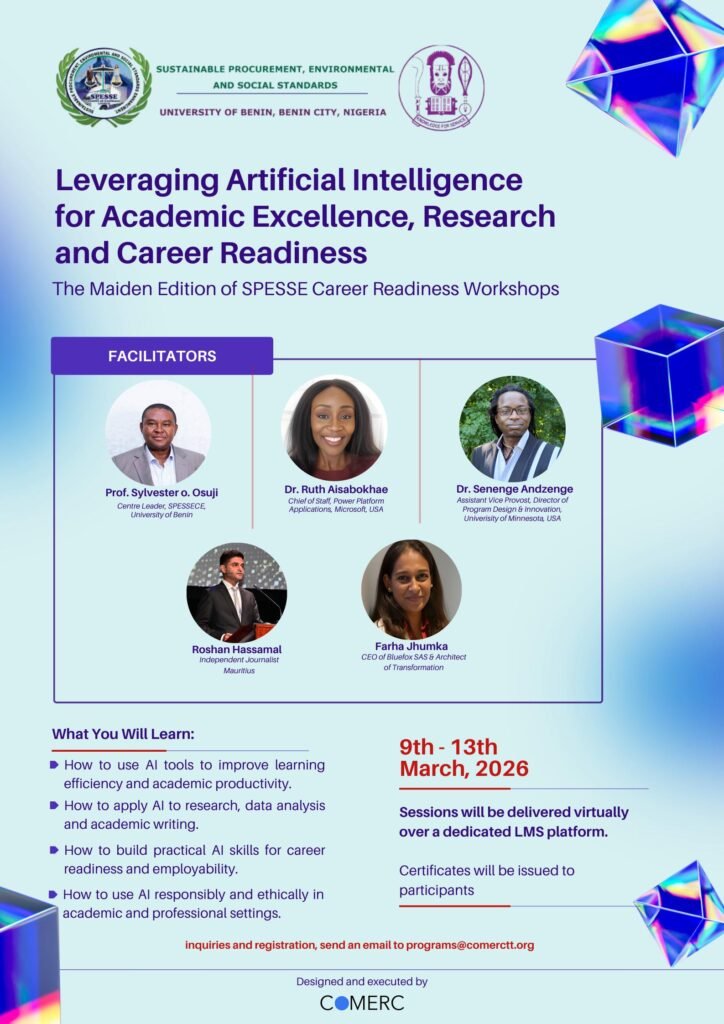
The program, themed Leveraging Artificial Intelligence for Academic Excellence, Research and Career Readiness, provided participants with a structured and highly relevant exposure to the foundational concepts of AI, its ethical implications, its application in academic and research work and its significance for employability and innovation in the modern world. The workshop agenda reflected a progression from introductory and conceptual themes to practical, reflective and career-oriented discussions over the five-day period.
The opening day of the workshop established both the intellectual tone and the practical direction of the program. Following the opening formalities, which included welcome and introductory remarks, participants were introduced to the first major session, titled “Artificial Intelligence: What It Is and Should We Be Scared?”, facilitated by Dr. Ruth Aisabokhae. This session served as an important foundation for the rest of the workshop. Dr. Ruth introduced participants to the meaning of Artificial Intelligence in a clear and accessible manner, helping them move beyond popular misconceptions and media-driven anxieties. The session addressed both the promise and the perceived threat of AI, giving participants a balanced understanding of how AI is already embedded in everyday life and institutional systems. Rather than sensationalizing the technology, the session encouraged thoughtful engagement with its realities.
A significant value-add to this session was the contribution of Nnamdi Ebere, a colleague of Dr. Ruth and a Microsoft employee, whose presence brought an industry perspective to the discussion. His contribution gave participants a broader appreciation of how AI is viewed and applied within global technology ecosystems. The session was especially important because it provided students with a mental framework for approaching AI neither with blind excitement nor with unproductive fear, but with informed curiosity and responsibility.
The second session on the first day, “AI for Learning Efficiency and Time Management,” also facilitated by Dr. Ruth Aisabokhae, took the discussion from understanding AI to applying it in the academic lives of students. In this session, participants were shown how AI tools can support learning by simplifying complex concepts, helping with organisation, generating learning resources and improving personal productivity. The session addressed common student challenges such as procrastination, poor time management, disorganised study methods and inefficient revision practices. AI was presented not as a substitute for discipline, but as a productivity enhancer that can help students structure their learning better and make more effective use of their time. This practical orientation made the session especially relevant to the SPESSE audience, as it directly responded to the lived realities of undergraduate students managing academic pressure and performance expectations.
The second day of the program continued the learning journey by focusing on learning productivity, cognitive depth and responsible academic use of AI. The first session of the day, “How Not to Get Dull Using AI,” was again facilitated by Dr. Ruth Aisabokhae. This session tackled one of the most pressing concerns around student use of AI: the danger of intellectual passivity. Dr. Ruth challenged participants to reflect critically on how they use AI and whether their engagement with the technology strengthens or weakens their own thinking capacities. The core message of the session was that while AI can increase speed and convenience, it must not be allowed to replace reflection, originality and deep understanding.
A memorable feature of this session was the inclusion of Alex, an MBA student at the University of Minneapolis, who shared her own academic experience and perspective on using AI productively without becoming overly dependent on it. This added a practical and relatable dimension to the discussion, helping participants see how similar concerns are being navigated in other academic settings. Alex also conducted live demonstrations using Quizlet, which illustrated practical ways students can use digital tools to reinforce memory, improve revision and remain mentally active while studying. The combination of conceptual discussion, peer insight and live demonstration made the session one of the most engaging of the workshop.
Later on the second day, Dr. Senenge Andzenge facilitated the session titled “AI Literacy and Responsible Use in Academic Environments: Academic Research and Plagiarism.” This session was especially important given the academic context of the participants. Dr. Andzenge approached the subject with openness and intellectual honesty, creating an environment in which students could discuss real concerns around AI, authorship, originality and academic misconduct. He explained that AI literacy is not simply about knowing how to use AI tools, but about understanding their strengths, limitations, risks and ethical implications. Particularly noteworthy was his disclosure that he had, for the first time, prepared his own training slides using Notebook LLM. This admission was powerful because it modelled exactly the kind of transparent and responsible AI use the session was advocating. Rather than presenting AI use as inherently problematic, the session showed that AI can be integrated into academic and professional workflows ethically, provided its use is disclosed appropriately and does not replace personal intellectual contribution. Participants were guided through issues such as plagiarism, attribution, originality and the responsibility of students to critically review, refine and own any work produced with AI assistance. This session helped place academic integrity at the centre of the workshop’s learning objectives and ensured that participants left with a more mature and disciplined understanding of AI-assisted scholarship.
The third day of the program was designated as Practical Day, a decision that reflected the organisers’ understanding that AI literacy is best developed not only through lectures and discussions, but also through application and active engagement. The agenda identifies this day broadly as a practical day, and its inclusion was a crucial part of the overall instructional design of the workshop. After two days of conceptual and reflective learning, the practical emphasis of Day Three created room for participants to engage more deeply with the ideas they had encountered and begin to internalise them in real terms. The practical component of the program likely helped participants consolidate their understanding of AI tools, ethical boundaries and context-appropriate applications in ways that would support future use. The presence of a practical day within the workshop structure also reinforced the workshop’s identity as a capacity-building program rather than a purely theoretical seminar. On the fourth day, the workshop shifted toward the role of AI in the workplace, innovation and society. The first session of the day, “AI Skills for the Modern Workplace,” was facilitated by Dr. Senenge Andzenge. This session introduced participants to the changing expectations of the contemporary work environment and the rising importance of AI-related competencies across sectors. Dr. Andzenge made the important point that AI is no longer relevant only to engineers or data scientists; rather, digital fluency and the ability to work productively with AI tools are increasingly valuable for professionals in a wide range of disciplines. The session highlighted the growing importance of adaptability, prompt thinking, digital confidence and the ability to use AI tools for communication, planning, problem-solving and decision-making.
For SPESSE students preparing to enter a rapidly evolving labour market, this session was especially timely. It broadened their understanding of employability and positioned AI literacy as an essential component of career readiness.
The final substantive learning session of the workshop was “Artificial Intelligence, Innovation and Social Impact,” facilitated by Farha Jhumka. Farha adopted a distinctive and thought-provoking approach to the subject by focusing not only on what AI can do, but on what AI usage and dependence may be doing to human beings and society. Rather than limiting the discussion to technological optimism or innovation metrics, she expanded the conversation to include human behaviour, attention, dependence and the subtle ways AI can shape social and psychological patterns.
Her session helped participants think more critically about the behavioural and societal implications of AI adoption. This broadened the workshop’s scope considerably, ensuring that participants did not leave with a narrow tool-based understanding of AI, but with a more reflective appreciation of its impact on identity, interaction and culture. In this sense, her contribution added philosophical and social depth to the programme and complemented the more practical and academic sessions delivered earlier in the week. Across the workshop, it became evident that the facilitators brought not only expertise but also diversity of method and perspective. Dr. Ruth Aisabokhae’s sessions were notable for their accessibility, relevance, practical orientation and the way they were enriched by the inclusion of guest contributors. In one of her later engagements within the program, she also brought in Aghogho, one of her mentees who has Nigerian roots, and this contribution further enhanced participant interaction and relatability. That session was described as highly interactive, underscoring Dr. Ruth’s ability to create participatory learning environments that appealed to students and encouraged lively engagement.
Dr. Senenge Andzenge’s style, on the other hand, was characterised by openness, transparency and a willingness to model ethical AI use through his own practice. Farha Jhumka contributed a broader social and behavioural lens that widened the scope of the workshop beyond academics and employability. Collectively, these facilitation styles ensured that the program remained dynamic, balanced and intellectually rich. The final day of the workshop, Friday, 13th March, 2026, was devoted to the closing ceremony, which included remarks from the Centre Leader of SPESSE Centre of Excellence, University of Benin, certificate issuance and closing remarks by the Program Coordinator.
The conclusion of the program marked the end of a week-long learning experience that had equipped participants with a stronger understanding of AI as a tool for academic excellence, research support, career readiness and responsible citizenship.
Overall, the SPESSE Career Readiness Workshop on Artificial Intelligence was a timely and impactful intervention. It succeeded in introducing participants to the key dimensions of AI that matter most in student life and beyond: foundational understanding, responsible use, cognitive discipline, research ethics, workplace relevance, innovation and social impact.
The workshop’s structure, facilitator quality, practical emphasis and thematic coherence all contributed to its success. For the students of SPESSE Centre, University of Benin, the program was not merely an introduction to AI tools; it was an invitation to become more thoughtful learners, more responsible researchers and more future-ready professionals in an increasingly AI-shaped world.